
Visitors to the Lab & What Happens Next
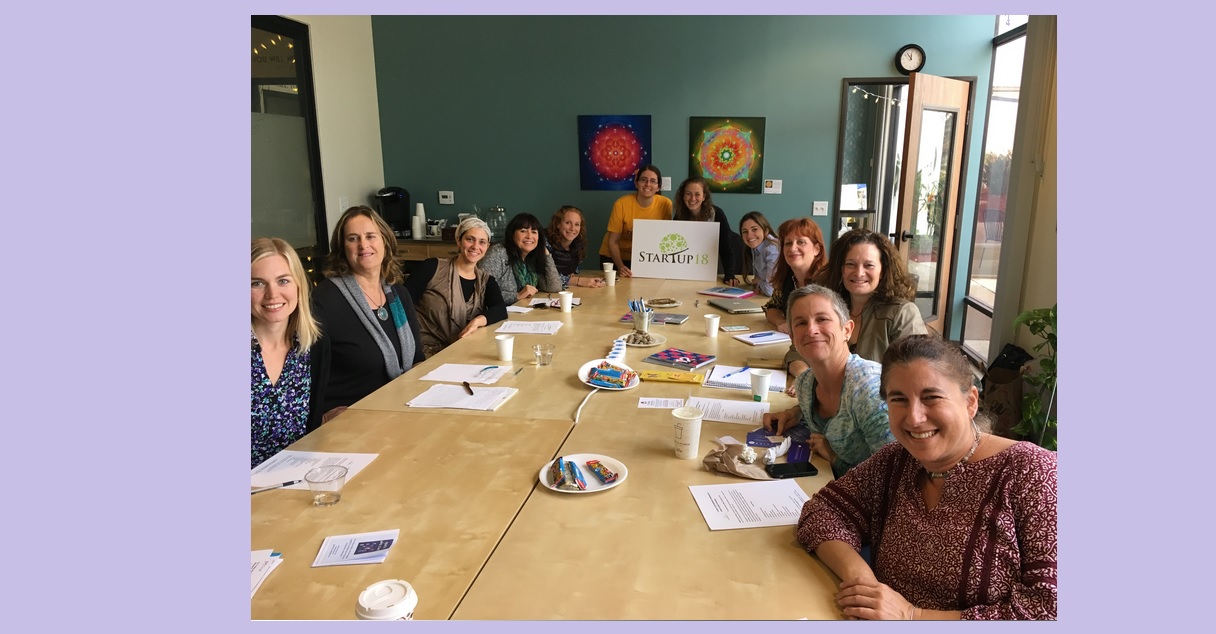
A young man in the community who has planned Jewish programs for his peers, for young adults, has high energy and is genuinely interested in Jewish life walked into our Jewish Engagement Lab this week curious about what goes on there. As he entered the room, he was warm, enthusiastic, and made his way, introducing himself and mingling with regulars from the Lab and newcomers alike.
Each time the Jewish Engagement Lab meets, 3-5 new people attend. 12-15 project founders network, share challenges, get advice and counsel and share the same. The warmth, and high energy is infectious. As new friends are made, and in some cases old acquaintances are refreshed, new relationships are forged and the opportunity to support each other is appreciated that much more.
We begin every Lab with a 2 minute overview from each person about their project if they have one, and if not, what led them to join us that day. The meeting continues with a topic relating to marketing, or prototyping, recruiting or fundraising, for grassroots Jewish program development in San Diego’s Jewish Community. We educate project founders how to do outreach because over 85% of our Jews are not engaged in traditional Jewish organizational life. This means it takes creativity and knowledge to reach them.
We love to see newcomers to the Lab. Why? Because they come, curious, making time out of their day and contribute. More often then not they come in the door without a specific purpose and walk out with one either supporting an existing project or they begin to consider founding their own.
So what happened with the young man that particular day? He found something interesting to do. Among the project founders in attendance at the Lab that day was Aviva Angel who is founding an Intentional Community in San Diego.
And what happened next? He joined Aviva enthusiastically for her first meeting for community members to learn more about the Intentional Community she has planned. Who knows what will come next. But, we love the Jewish engagement story.
Interested in learning more about Startup18 projects? Check them out here.
Interested in learning more about the Intentional Jewish Community in San Diego?
To learn more visit:
Data and “Jewish Urban Planning”

[The second post in The Nuts & Bolts of Jewish Entrepreneurship series]
As Jewish innovators, when we pilot, we learn a lot about our community’s hopes and dreams as we build. Though, ideally you’d know how many are in your target market, where they are and how to reach them, before you launch your program, that’s not always the case. Every pilot we launch provides us with feedback and data that helps us program more successfully. In a sense, we are “Jewish Urban Planners” or trailblazers at the very least. But is that enough to be successful?
Missing Data
Often, there is no research or data available. The last formal study of my community in San Diego was in 2003 when we learned over 85% of our population was not engaged in traditional Jewish life. We don’t know why or even if it’s better or worse today. No new study has been done. There’s been no analysis of what our community at large might want. Youth K-8 Jewish education is in particularly bad shape with only 8% of our Jewish children engaged in Jewish recurring education. The latter statistic is based on data we stopped collecting as a community in 2014 when our program supporting local Jewish educators closed. The lack of data, it turns out, is not uncommon. So where can you start as you begin your research?
Consult National Studies
National and International Jewish research is available to guide your work. Read the Pew Research Center’s report on Jewish Americans from 2013, as a baseline and get familiar with work from at least two researchers such as Steven Cohen and Gidi Grinstein who have studied a variety of Jewish population segments and programs. Last week, the Jewish People Policy Institute released two informative studies, too: Family, Engagement, and Jewish Continuity among American Jews and Learning Jewishness, Jewish Education, and Jewish Identity.
Dealing with Realities
The national trends reflect that huge numbers of American Jews are not engaging in traditional Jewish life and institutions and that many don’t identify with denominations; instead, framing their Jewish identity in cultural or “just Jewish” terms. The newer studies also highlight our failure to engage youth in Jewish education programs. However, the studies emphasize the need for adult programs, because young Jews in America are marrying later, having children later and fewer of them. This delay and lack of creative Jewish social circles with which to engage can lead to a disconnect from the community for both parents and their children.
Using National Data
What can a Jewish innovator learn from these studies that might help? The studies encourage building new avenues for Jewish social circles for youth and for adults. They also encourage youth participation in multiple types of Jewish experiences through youth because, for many, there is no longer a central institution – synagogue or other center – that is a preferred gathering place. Camps of all kinds, even for adults, innovative after-school programs and creative Jewish education as a family experience are all winning combinations, resulting in successful Jewish identity and community-building.
Gathering Your Own Data
National research continually shows there is ample interest and enthusiasm in Jewish America for new ways to engage. These results should inspire us to pilot, test and build. Jewish innovators are trailblazers. We listen, we pilot, take feedback, and pivot, shaping new programs as we go. To that end, we should look to our local Jewish Federation and/or Foundations to see if they have completed local studies, but, if they haven’t, we should charge ahead, conducting small focus groups, piloting new programs, and trailblazing, gathering and sharing the data along the way.
Healthy Jewish Collaboration & Reciprocity
Jewish collaboration requires a courtship to understand synergies and opportunities, overcome pitfalls, and create mutually beneficial collaboration. It’s about creating something new and great neither organization could do themselves. We reach new people, build different and better programming, or simply help nurture and support each other’s existence. This kind of authentic collaboration is the Holy Grail of greater engagement of the Jewish people. It’s what makes the difference in good to great, in rote vs. inspiring and it’s what feeds our Jewish soul and invigorates us.
Jewish partners take risks, sharing their resources, but also planning reciprocal programs and marketing the benefits for both or all of the organizations involved. They are committed, courageous, and have an enthusiastic desire to see an improved landscape of Jewish experiences. Foundations in making grants often encourage collaboration, but there is no road map that suggests best practices on how to do it.
Without the training or best practices to guide us, many Jewish organizations – in fact, many Jewish entrepreneurs – don’t know how to pave the path. There are local and national collaborations, even secular, Jewish and Israeli to consider. Each can bring unique resources, opportunities and open important doors, not only to recruiting and outreach, but also to programmatic improvements and continuity.
Collaborative Pitfalls – Don’t Let Them Get You Down!
Each of the following represents pitfalls that are surmountable. Like love and marriage, it takes work to make collaborations successful. It also takes two willing and interested parties.
Better My Way: We do things our way, if you do it this way, we can partner.
Answer: Don’t assume a partner or collaboration can only be one way and then take the highway. And don’t let a partner do so, either. Collaboration begins with a conversation that considers community needs and partner needs. Listen, give and take feedback, share advice, consider community historical data (i.e. learning from what’s been tried), and craft an artful creation well-tailored to your community needs.
FUD: Fear, uncertainty and dread. We might lose participants or members; we can’t afford that. Maybe they’ll like the other program better, their staff or rabbi more.
Answer: We need courageous, risk-taking Jewish leadership, especially in communities with ridiculously low Jewish engagement and significant Jewish populations.
Scarcity of Resources: We’re too busy to work on that, to give them attention. They have to pay big money to be a Partner. We have costs to cover.
Answer: Use your staff or volunteers better; let them impact more people. Use your building better; Jewish buildings were meant to be full of Jews. Develop a reasonable rental plan or, better yet, in kind use with a plan for collaborative or joint programs.
Programmatic Differences: We’re different because of the languages we speak together, levels of observance, culture or age.
Answer: Encourage mingling, to meet and learn from each other. It’s interesting and healthy to build bridges; to be with people speaking Spanish, Hebrew, Russian; hearing and experiencing their Jewish cultural traditions. Most Jewish community members want to make new Jewish connections. Work together and help them.
Marketing Limitations: “Just send out our event flyer/fundraiser but, oh, by the way, we can’t reciprocate and share yours”, “Our Board won’t let us”, “My boss won’t let me”, and/or “We don’t think our people will be interested in yours.” (Translation: “We just want to use you, not collaborate with you.”)
Answer: Healthy Jewish collaboration requires reciprocity. Be aware there are labor and tangible costs for quality marketing and know that someone needs to cover those costs. Recognizing one partner or another may bear the brunt of this should be considered and made up for in other ways to make it work.
Courtship & Collaboration – This is the Fun Part!
With the enormous number of less or not engaged, and the expense of running programs, buildings, and staffing, it goes without saying we should be leveraging our resources better. Let’s face it: some programs have a great staffer or rabbi, some have a great building, and some recruit and produce great programs. Just like in dating, this is the fun part. This is where you get to see what’s great about each other. Plan how to share resources and expenses, respecting each other’s limitations, appreciating the strength in each others’ staffing or experiences and getting creative about offering better programs together. Then, establish a respectful and reciprocal marketing plan for the joint program, creating exciting pieces that share the joint event, proudly sharing the relationship, your enthusiasm for the other and cherishing the benefit you bring together to the community. You don’t have to agree to spam your respective databases with every event the other does. Work hard on a few joint events and promote those like crazy.
From Good to Great! Collaboration Stories
Market another program that has synergies with your own. Share resources funded by programs with your same mission. If you work with young children, for example, teaching Hebrew or Jewish values, share information about the Israeli-American Council’s Keshet Sfarim or the PJ Library. Helping these organizations register families is a great opportunity, too, for Jewish outreach. Using the books in your supplementary school programs and offering free Hebrew story times in public libraries and on Jewish day school campuses can only mean more learning opportunities and a win-win for both organizations. Partner with summer overnight and local camps who can share madrichim in partnered programs through the year. Leveraging the resources of both organizations for community-wide events is a tremendous marketing opportunity for all. Jointly marketed events can be shared prominently by all the organizations in their newsletters, Facebook pages and web sites, showing deep and authentic appreciation for each other’s identities, efforts and the relationship.
Synagogues and traditional organizations like a JCC or Jewish Family Services can make great partners, too. They may generously offer low or no cost meeting space and, together, you can create beautiful Jewish experiences, memorable Sukkot dinners, Shabbat evenings and more. Programs successful in recruiting less engaged families can make introductions this way to more Jewish friends in synagogues, and traditional bar/bat mitzvah programs, perhaps even synagogue membership or additional programs offered by the local JCC or Jewish Family Services organizations. In fact, many Jewish startups might begin this way, with these close collaborations, only to find that, as they mature, there may be good reasons to wrap the programs into the organization’s portfolio rather than go it alone for a long-term win-win for the community.
Looking Ahead
Working together, exploring ways to engage more Jews, I hope each Jewish organization that might read this near, or far, and Jewish startup entrepreneurs will be encouraged to make the time to work with potential Jewish partners, to be courageous, generous, creative, and patient and to engage more Jews every day. It’s exciting to be a part of a creative, collaborative process. Together, collaboratively, we’ll enrich our Jewish communities and ensure our Jewish future and connection to Israel.
This article is the first in a series about Jewish Entrepreneurship; the nuts and bolts, and lessons learned, from experiences transforming Jewish life in San Diego, CA.


 San Diego Israel and Jewish